

We gave one read-only WordPress inventory job to three models through the same Hermes agent: Qwen 27B and Muse Glimmer 30B running locally on a Mac Studio, and DeepSeek V4 Flash in the cloud. All three returned the correct answer. The cloud model reached its first action in 4.4 seconds; the slower local model took 223.6. But the timing is the least interesting thing that happened.
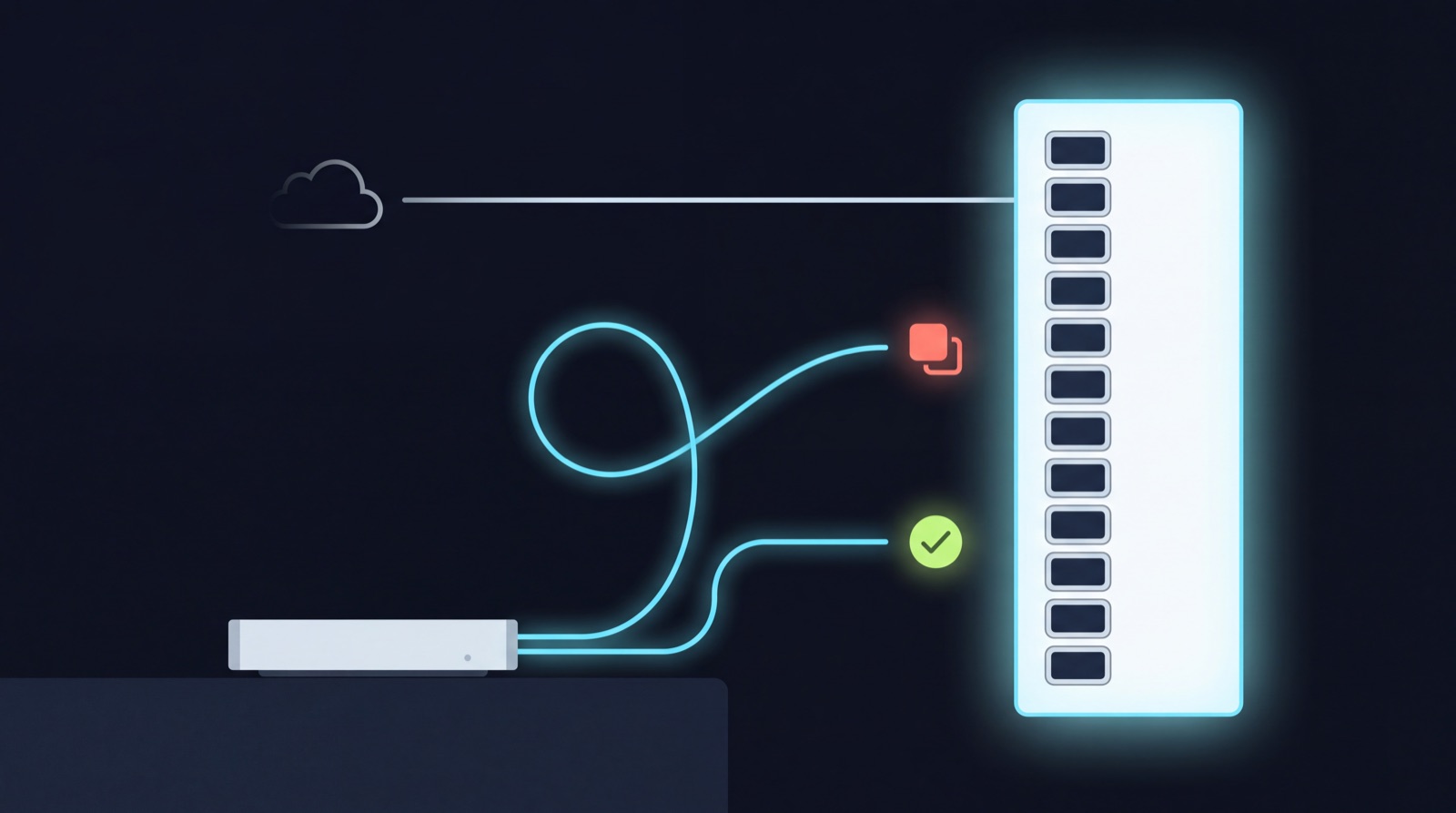
This is a field report, not a benchmark. The three runs shared a profile, a site, a connector action and an expected result — but they did not share a byte-identical prompt, an invocation platform, a controlled cold/warm model state, or an isolated endpoint. There is one run per configuration. Treat every number below as a description of what happened on one afternoon, not as a measurement of what these models are worth.
A deliberately boring job
The task was the smallest useful thing an operations agent does: connect to a WordPress site, call one read-only action, and report what is installed. The site was clientsite.example. The action was fluent_inventory. The correct answer was 12 Fluent and Stifli plugins.
Boring is the point. There is no reasoning to admire and no code to review. Either the agent reaches the tool, reads the result faithfully, and says so in the required format, or it does not. That makes the differences between models unusually legible.
Environment held constant
- Hermes profile
siteclient, siteclientsite.example(the client’s real domain is redacted; the placeholders keep the shape of the error — one wrong letter in the middle of the name) - Read-only connector action
site_wordpress.fluent_inventory, expected count 12 - Local models served from a Mac Studio on the same Tailscale network, ~1 ms round trip
- Hermes payload: ~12.5 KB system prompt plus ~37.3 KB of schemas for 29 tools
- Context window 65,536 tokens · reasoning effort medium
Timing definitions — taken from persisted Hermes session-message timestamps, not a stopwatch.
- First action: first assistant message or tool call, minus the initial user message.
- Total: final assistant message with
finish_reason=stop, minus the initial user message.
What happened
All three runs called the same read-only action and all three returned 12. On correctness of the underlying task, this was a three-way tie. Everything that follows is about how long it took and what came back around the answer.
Time to first action Seconds from the user message to the first tool call · shorter is better
Cyan marks a model running on the Mac Studio. Model residency was not controlled, so part of the local delay may be load time rather than inference.
Total time to finish Seconds to the final assistant message · shorter is better
Muse finished about 3.1× faster than Qwen and about 9.1× slower than DeepSeek. Qwen was about 28.5× slower than DeepSeek overall, and about 50× slower to its first action.
| Model | Where | First action | Total | Tool calls | Input tokens | Output tokens | Output chars |
|---|---|---|---|---|---|---|---|
| qwen3.8:27b-mlx | Mac Studio | 223.620 s | 305.790 s | 5 | 52,474 | 1,060 | 1,447 |
| muse-glimmer:30b-mlx | Mac Studio | 56.292 s | 97.904 s | 3 | 45,559 | 816 | 486 |
| deepseek-v4-flash | Cloud | 4.430 s | 10.730 s | 3 | 47,521 | 229 | 38 |
The compliance column is not what it looks like
Every run was asked to open with a machine-parseable line naming the site and the count. This is the part of the job an automation actually depends on: a downstream script reads that first line and never sees the prose underneath.
Here is what each model returned, verbatim.
Qwen 27B · session 20260902_222931_b1ffb30b
SITE_AGENT_OK clientsute.example 12
The domain is misspelled — clientsute.example, one vowel wrong. The response went on to correct itself in prose, return a complete and accurate 12-row table, and document that its access was read-only. The prose was good. The first line, the only part a parser reads, was wrong.
Muse Glimmer 30B · session 20260902_234152_8eb663
SITE_AGENT_OK clientsite.example 12

plugin                  version  status
fluent-security         2.1.2    active
fluent-cart             1.6.3    active
fluent-community        2.8.1    active
fluent-community-pro    2.8.1    active
fluent-crm              3.1.13   active
fluentform              6.2.13   active
fluentformpro           6.2.13   active
fluent-messaging        2.7.5    active
fluent-player-pro       1.4.0    active
fluent-player           1.4.0    active
fluent-smtp             2.3.1    active
stifli-flex-mcp         3.4.8    active

site: clientsite.example
access: read
DeepSeek V4 Flash · session 20260902_224503_0de915ff
SITE_AGENT_READY clientsite.example 12Read those three together and the obvious ranking dissolves. Muse produced an exact sentinel and a complete table — but its prompt was the only one that explicitly asked for a table. DeepSeek returned 38 characters, which looks like admirable concision until you notice its prompt never requested a table either. And DeepSeek’s sentinel token is SITE_AGENT_READY where the other two required SITE_AGENT_OK; our own record does not state which token DeepSeek was asked for.
So we can report first-line compliance for the two runs that shared a rule, and we cannot compare the third against them. That is an unsatisfying sentence to publish. It is also the honest one.
| Model | Correct count | Exact first line | Table returned | Table requested? |
|---|---|---|---|---|
| Qwen 27B | Yes | No — domain typo | Yes, 12 rows | No — volunteered |
| Muse Glimmer 30B | Yes | Yes | Yes, 12 rows | Yes |
| DeepSeek V4 Flash | Yes | Not comparable | No | No |
The typo matters more than the clock
A slow agent is an inconvenience you can schedule around. An agent that emits a confidently formatted, subtly wrong identifier is a different category of problem.
clientsute.example is not a parse error or a refusal. It is a well-formed domain that happens to be the wrong one, sitting in the exact position a downstream script trusts. Had a workflow branched on that line — writing a report, opening a ticket, selecting a site to act on — it would have branched on a site that does not exist, and the model’s own graceful correction two paragraphs later would have gone unread.
This is the finding we would actually act on. It says nothing about Qwen in general; a single run cannot. It says a great deal about where to put validation: parse the sentinel, assert the domain against the profile you dispatched, and fail loudly rather than trusting well-formed output.
Why local was slow here
Not because the network was slow. Round-trip time to the Mac Studio was about a millisecond. The cost is structural, and it is worth understanding because it applies to any agent workload on Apple silicon.
Hermes hands the model roughly 12.5 KB of instructions plus 37.3 KB of tool schemas — 29 tools — before the task is even described. Every discovery step and every tool result requires another full pass over that context. Qwen took five tool turns to Muse’s and DeepSeek’s three, so it paid that cost nearly twice as often.
Two further conditions were not controlled and plausibly contributed. The endpoint held several large models resident, so requests may have queued behind other work; during setup a trivial request once took 31 seconds on the same machine. And model residency was never deliberately managed, so an unknown share of Qwen’s 223-second first action may be load time rather than inference. We cannot separate those from the measurement, which is precisely why this is a field report.
Four conclusions this run does not support
The numbers above are easy to over-read. Four readings that would be wrong:
“Local is 28× slower than cloud.” One run per configuration, with residency and endpoint contention uncontrolled. This is a single observation, not a ratio you can carry to another machine.
“DeepSeek is the most concise.” It answered a question that did not ask for a table. Thirty-eight characters is the right length for its prompt and tells you nothing about how it summarises when asked to.
“Qwen is the most thorough.” Its table was unsolicited. Volunteering extra output is not the same as following instructions, and on the instruction it was given — the first line — it was the only model to get the domain wrong.
“Qwen used the most input tokens, so it is least efficient.” These counters accumulate harness and tool context across turns; they are not unique prompt size. Qwen’s higher count largely reflects taking five turns instead of three.
What a decision-grade test would need
We are publishing the weak version because the method is the useful part. To turn this into something you could make a purchasing decision on:
One byte-identical prompt for every model, with the same output contract — same sentinel token, same table requirement. One invocation platform; here Muse ran through a CLI one-shot while Qwen and DeepSeek were recorded through Mattermost. Deliberate cold and warm states, evicting and reloading models rather than letting residency fall where it may. An isolated endpoint with no other resident models and no concurrent load. At least three cold and three warm runs per model. And medians with variance reported, not single values.
What we changed on our own stack
DeepSeek is the default for interactive agent work where somebody is waiting. Ten seconds is a pause; five minutes is an abandoned task.
Muse Glimmer at roughly 98 seconds total sits in genuinely useful territory for scheduled and background jobs — inventory sweeps, nightly checks, anything where no human is blocked. Qwen at over five minutes, on this endpoint under these conditions, is not something we would put in an interactive loop.
And regardless of model, the sentinel line is now validated rather than trusted. That change came from the typo, not from the timings.
Limitations. Prompts were similar but not byte-identical, and required different sentinel tokens. Muse ran through a CLI one-shot; Qwen and DeepSeek through Mattermost. Model cold/warm residency was not controlled. Endpoint queueing and concurrent model load were not controlled. There is one run per recorded configuration. Input-token counters include repeated harness and tool context across turns and are not equivalent to unique prompt size. No conclusion here extends beyond this Hermes workflow on this hardware on this day.
Sessions: Qwen 20260902_222931_b1ffb30b · DeepSeek 20260902_224503_0de915ff · Muse Glimmer 20260902_234152_8eb663. Timings read from persisted Hermes session-message timestamps. Evidence package and machine-readable run record held internally as HER-5; reusable procedure as HER-6.